The most effective way to close more deals as a marketing agency or MSP is to fix how you present and deliver proposals — not to lower your prices. Agencies and IT service providers that consistently win work share seven proposal habits: they open with a direct answer instead of a company bio, offer structured pricing options, define scope so there's nothing to debate, format proposals for easy scanning, hold live review meetings, build trust before the document lands, and send proposals fast. Industry data consistently shows that proposals sent within the first day of a sales conversation close at significantly higher rates than those sent a week later. Most of these are process and presentation changes that any team can implement in 30 days.
Why do marketing agencies and MSPs lose deals on proposals?
Before diving into fixes, it helps to understand why proposals stall. The reasons are usually the same whether you're pitching a marketing retainer or a managed services agreement:
- The proposal is confusing. The client can't figure out what they're getting or what it costs. For marketing agencies, this often means vague deliverables like "social media management" without specifying post volume, platforms, or reporting. For MSPs, it might mean bundling so many services that the client can't tell what's essential versus optional.
- There's no urgency to decide. The proposal doesn't frame the timeline or cost of inaction, so it sits in an inbox while the client handles other priorities.
- The client feels locked in. One price, one scope, take it or leave it. No flexibility means no room to say yes on their terms.
- Trust hasn't been established. The proposal arrives before the client feels confident in the relationship or the team's understanding of their business.
- It took too long. By the time the proposal lands, the client has already moved on or chosen a competitor who responded faster.
Research consistently shows that winning sellers are differentiated by how they collaborate, educate, and communicate value — not by offering the lowest price. With that in mind, here are seven strategies that address these failure points directly.
How should your proposal open to keep clients reading?
Most proposals open with a paragraph about the agency — mission statement, years in business, team bios. Clients skip it. They're looking for one thing: what are you going to do for me, and what will it cost?
Lead with a direct summary of what you're proposing, who it's for, and the expected outcome. Think of it as answering the client's unspoken question: "Should I keep reading?"
For a marketing agency, that might look like:
- "This proposal covers a 6-month content marketing engagement for [Client], focused on organic lead generation through SEO-driven blog content and LinkedIn strategy. Monthly investment ranges from $4,500 to $7,200 depending on the options below."
For an MSP or IT firm:
- "This proposal outlines a managed IT services agreement for [Client]'s 45-person team, covering helpdesk support, network monitoring, cybersecurity, and quarterly business reviews. Monthly plans start at $3,200."
No preamble. The client immediately knows what they're evaluating and whether it fits their budget — and they're far more likely to read the rest. For a deeper look at what sections to include after the opening, see the must-have sections in a service-based proposal.
Should you offer multiple pricing options in agency and MSP proposals?
Yes. Single-price proposals force a binary decision: yes or no. When you present two or three structured options, the client's mental question shifts from "Should I buy?" to "Which option fits best?" This is grounded in decision psychology — anchoring a higher-value option alongside a mid-range recommendation makes the mid-range feel reasonable, and giving the client a way to start smaller removes the objection that the scope is too big or too expensive.
How this works for marketing agencies:
- Tiered retainers — e.g., Essentials ($3,500/mo for SEO + blog), Growth ($5,500/mo adds paid media management), and Scale ($8,000/mo adds conversion optimization and monthly reporting)
- Core scope + optional add-ons — base website redesign with optional add-ons for copywriting, photography, or ongoing maintenance
How this works for MSPs and IT firms:
- Service tiers — e.g., Basic (remote helpdesk + monitoring), Standard (adds on-site support + security), Premium (adds vCIO + strategic planning)
- Per-user pricing with optional modules — base managed services at $125/user/month with add-ons for backup, compliance, or advanced endpoint protection
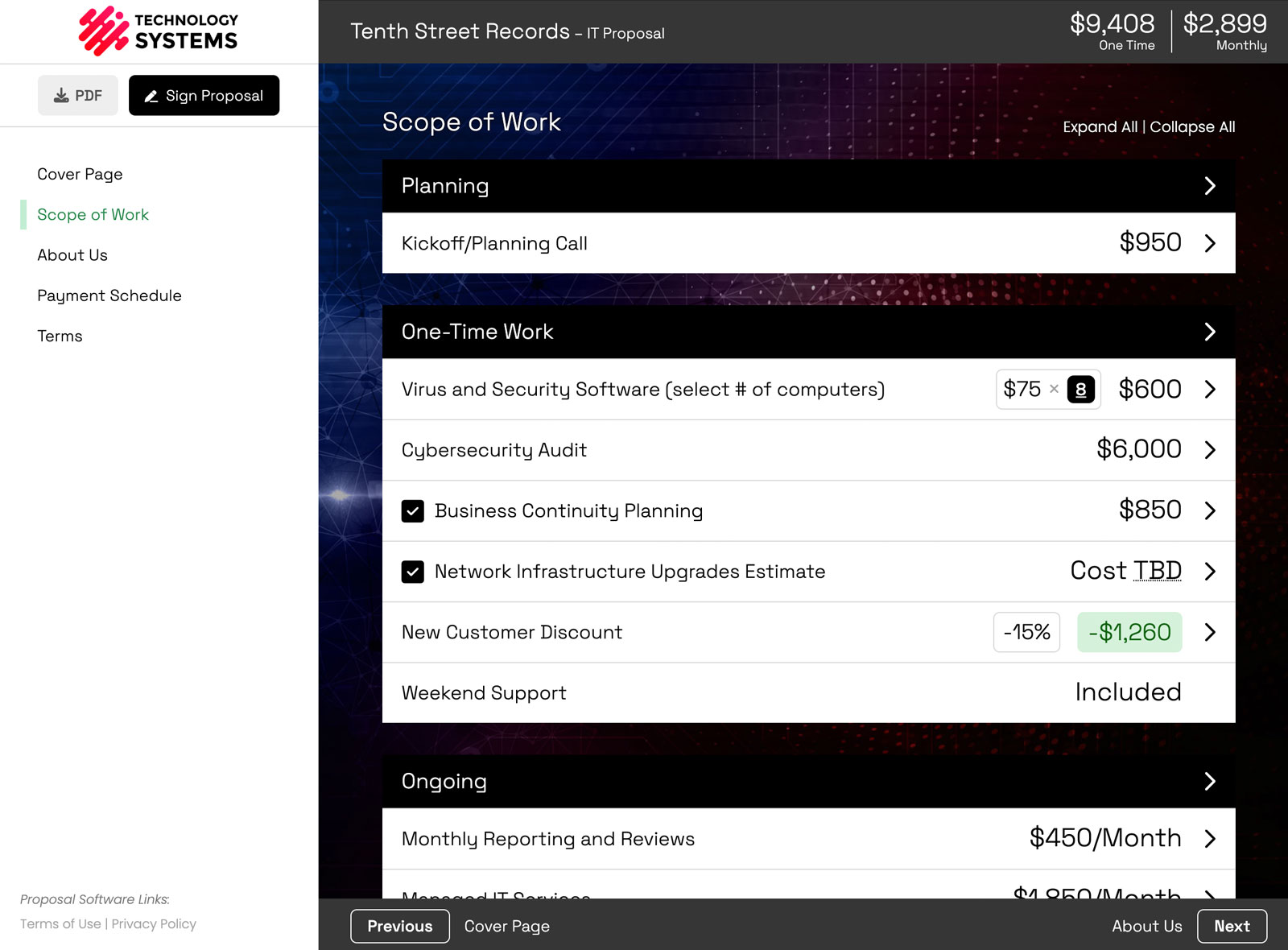
The key is keeping options scannable. If your pricing requires a spreadsheet to decode, you've created confusion, not flexibility. Tools that support side-by-side comparisons and interactive pricing make this far easier than a static PDF. For more on structuring options, read the smart way to offer multiple pricing options.
How does defining scope help close more deals?
Ambiguous scope is one of the most common reasons agency and MSP deals stall. If the client isn't sure what's included — or what's not — they hesitate. That hesitation turns into internal discussions, follow-up emails, and eventually "we'll circle back later."
A clear scope section answers three questions:
- What's included? List every deliverable with enough detail that both sides agree on what "done" looks like.
- What's excluded? Call out common assumptions. For a marketing agency: "This proposal does not include paid ad spend, stock photography licensing, or third-party tool subscriptions." For an MSP: "This agreement does not cover hardware procurement, cabling, or projects outside standard support."
- What happens when scope changes? State your change-order process so the client knows how additions are handled and priced.
Defined scope also protects your margins after the deal closes. Scope creep is one of the biggest profit killers for agencies and IT service firms, and it almost always starts with a vague proposal. See the 4-step system that stops scope creep for a structured approach.
Does proposal formatting actually affect close rates?
Yes — significantly. Most clients don't read proposals front to back the first time. They skim. They jump to pricing, glance at scope, and scan for anything that feels off. If your proposal is a wall of text or an unformatted PDF, the client will miss the parts that should close the deal.
Best practices for scannable agency and MSP proposals:
- Clear section headings. Each section answers one question: what we'll do, what it costs, what's included, what happens next.
- Short paragraphs and bullet points. No paragraph longer than 3-4 sentences.
- Key numbers stand out. Total investment, timeline, and deliverable count should be visible at a glance.
- Visual hierarchy. Bold key terms, use tables for pricing comparisons, and use professional design and branding that matches your agency's identity.
A polished proposal signals the same professionalism clients expect in the work itself. Interactive proposals that let clients explore options and see pricing in real time tend to outperform static PDFs on both engagement and close rate. For more on why format matters, see why most PDF proposals die unread.
What is a proposal review meeting and does it improve close rates?
A proposal review meeting is a short live conversation — typically 15 to 30 minutes — where you walk the client through the proposal before asking for a decision. It's one of the highest-impact changes a marketing agency or MSP can make to their sales process.
Sending a proposal over email and waiting for a response is the norm, but it's also where most deals quietly die. A review meeting changes the dynamic:
- You address objections in real time instead of letting them stall the deal for days
- You can explain pricing options and recommend the best fit for the client's situation
- It creates a natural next step ("When would you like to kick off?") instead of an open-ended wait
- The client feels heard, which builds confidence in the working relationship
This applies equally to a marketing agency presenting a campaign strategy and an MSP walking through a managed services agreement. The format doesn't need to be formal — a screen-share where you walk through key sections is enough. Read more about why proposal review meetings are non-negotiable.
How do you build client trust before the proposal lands?
A proposal confirms trust — it doesn't create it. If the client doesn't feel confident in your team by the time the document arrives, the proposal itself rarely bridges the gap. Trust is built in the conversations and interactions before you hit send.
For marketing agencies:
- Share a relevant case study or sample proposal from a similar industry or engagement type
- During discovery, reference specific challenges in their market rather than asking generic questions
- Send a brief recap email after your discovery call summarizing what you heard — it shows you were listening
For MSPs and IT firms:
- Offer a complimentary network assessment or security audit before proposing — it demonstrates competence and uncovers real needs
- Reference specific compliance frameworks relevant to their business (HIPAA, SOC 2, PCI-DSS) to show industry understanding
- Share documentation of your support process and SLAs upfront so they know what to expect before reading the proposal
The proposal should feel like a natural continuation of a conversation that's already going well — not a cold document arriving out of context. For more, see how to build trust before they read your proposal.
How fast should you send a proposal after a sales call?
Within 24 to 48 hours. The data on proposal timing is consistent across industries: faster proposals close at higher rates. The highest-performing teams send proposals significantly faster than their peers. When a client is still thinking about the problem you discussed, your proposal has momentum. Wait a week, and that urgency fades — or a competitor fills the gap.
Speed doesn't mean rushing or cutting corners. It means having systems that eliminate repetitive work:
- Reusable templates. A template library with pre-built proposal structures for your most common engagements — whether that's a marketing retainer, a website project, or a managed services agreement.
- A service catalog. Pre-built line items with descriptions and pricing so you're assembling proposals, not writing from scratch. Marketing agencies might have line items for SEO audits, content calendars, or social media packages. MSPs might have per-user pricing blocks, security add-ons, or project-based modules.
- Modular scope sections. Reusable scope blocks, terms, and case studies that drop into any proposal with minimal edits.
The goal is to spend time on what needs to be custom — the client's specific situation — and systematize everything else. See how to fix slow proposals in 30 days for a step-by-step approach.
Where should marketing agencies and MSPs start?
You don't need to implement all seven strategies at once. Start with the one that addresses your biggest bottleneck:
- Proposals stall with no response? Start holding review meetings and follow up with a specific question, not "just checking in."
- Clients say "it's too expensive"? Add pricing options and tighten your scope definitions so the value is clear at each tier.
- Competitors keep winning deals you thought were yours? Speed up your turnaround and lead with a direct answer in the opening paragraph.
- Getting discovery meetings but not closing? Focus on trust-building before the proposal and format the document so it's easy to scan and share internally.
Each strategy reinforces the others. Faster proposals with better structure and clear pricing options create a compounding effect on your close rate over time. Whether you're a marketing agency sending campaign proposals or an MSP pitching managed services agreements, the fundamentals are the same.
FAQ: Closing more deals with agency and MSP proposals
What is a good proposal close rate for marketing agencies?
Most marketing agencies target between 25% and 50%, depending on deal size and how qualified the leads are. If your close rate is below 20%, the issue is usually presentation or process rather than pricing. Improving even one of the strategies above — especially adding pricing options or holding review meetings — can move the needle quickly.
What is a good proposal close rate for MSPs?
MSPs and IT service firms generally see close rates in the 30% to 60% range for qualified opportunities, though this varies by deal type. Break-fix quotes tend to close faster; larger managed services agreements take longer but benefit most from structured options and live review meetings.
How many pricing options should a proposal include?
Two to three options is the sweet spot for most agency and MSP proposals. One option forces a yes-or-no decision. Four or more creates decision fatigue. Structure options so the client can clearly see what each tier includes and which one you recommend as the best fit.
Should I follow up after sending a proposal?
Yes — but a proposal review meeting is far more effective than a "just checking in" email. If a review meeting isn't possible, follow up within 2-3 days with a specific question ("Did the timeline work for your team?" or "Any questions about the service tiers?"). Avoid generic follow-ups that are easy to ignore.
Does proposal software help agencies and MSPs close more deals?
When used well, yes. The advantage isn't the software itself but what it enables: faster turnaround, interactive pricing options, professional formatting, and tracking so you know when a client has viewed the proposal. The combination of speed, presentation, and data gives teams a meaningful edge over competitors still sending static PDFs. See how proposal software features support these strategies in practice.
Closing more deals starts with how you sell, not what you sell. Pair these strategies with the psychology behind proposal pricing and how to streamline proposal creation at your agency for even more impact. If you'd like to see how interactive proposals with structured pricing options work for marketing agencies or IT service firms, book a short demo and we'll walk through a real example.