Why do some agencies consistently close deals at premium rates while others struggle to justify even basic pricing? The answer isn't better services or slicker presentations—it's understanding the psychology behind how clients make pricing decisions.
When clients evaluate proposals, they're not just comparing features and costs. They're making emotional decisions about trust, value, and risk. Understanding this psychology can transform how you present pricing—and dramatically improve your close rates.
Here's what research reveals about pricing psychology—and how to use it to your advantage.
The Paradox of Choice: Why More Options Mean Higher Sales
Conventional wisdom says too many choices overwhelm clients. But when it comes to pricing, the opposite is true. Clients don't want to be told what to buy—they want to feel like they're choosing what's right for them.
This is the internal dialogue running through every prospect's mind. They're not just buying a service—they're making a decision they'll have to justify to their boss, their board, or themselves.
The Solution: Give them three clear options that make the decision feel obvious.
Essential Package: $8,500
Core redesign with mobile optimization and basic SEO
Professional Package: $15,000 ← Most Popular
Everything in Essential plus advanced analytics, conversion optimization, and 3 months of updates
Premium Package: $24,000
Complete digital transformation with custom integrations, ongoing optimization, and priority support
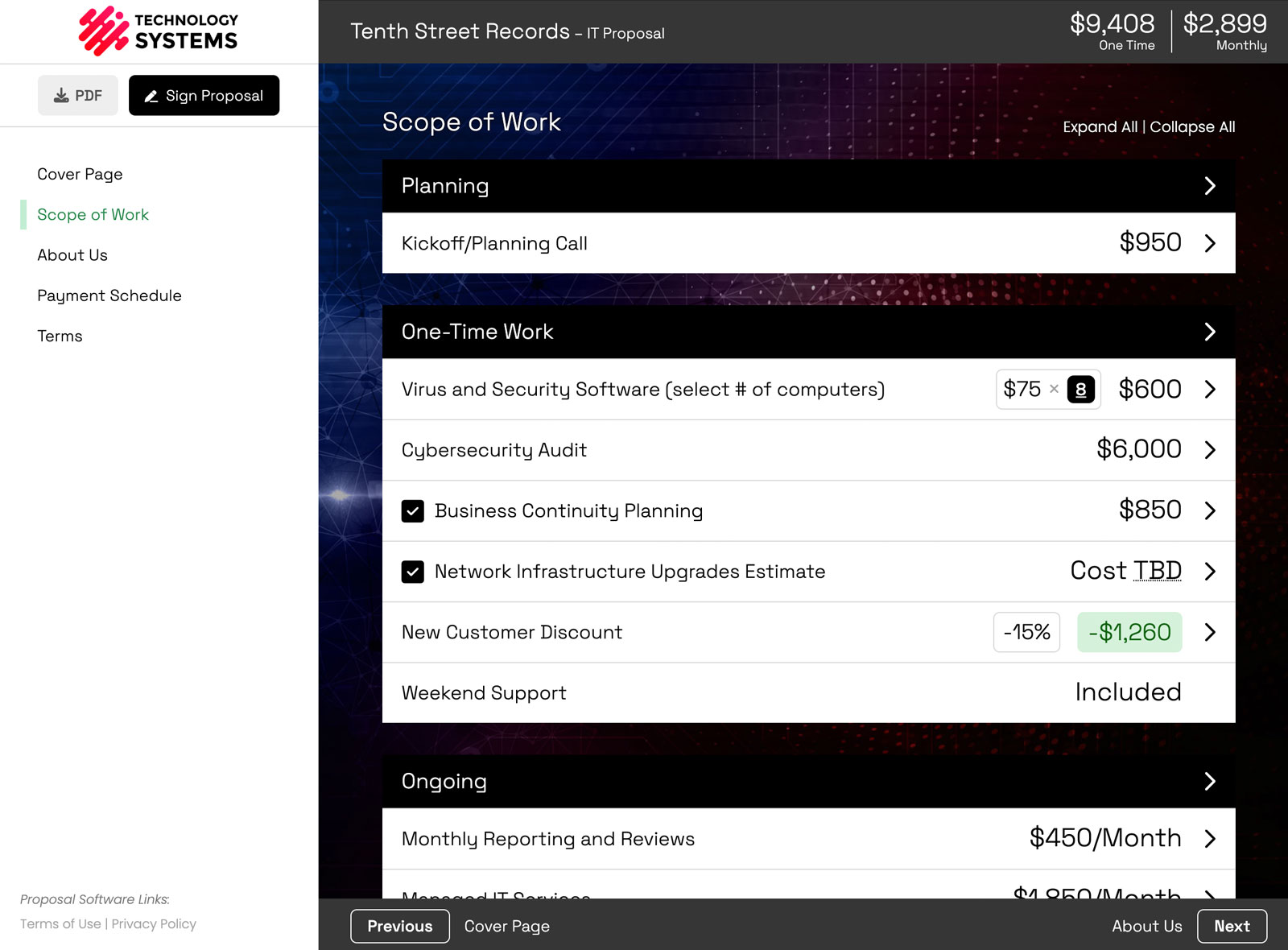
Notice what happens here? The middle option suddenly looks reasonable compared to the premium, but comprehensive compared to the basic. This is called anchoring, and modern proposal software makes it easy to present these options interactively, letting clients explore what each package includes.
The Power of Framing: Investment vs. Cost
Here's a simple test: Which sounds more appealing?
Option A: "This project costs $15,000."
Option B: "This $15,000 investment typically generates $60,000 in additional revenue within 12 months."
Same price, completely different psychological impact. Option A focuses on what they're losing (money). Option B focuses on what they're gaining (results).
When you frame pricing as an investment with measurable returns, you're not asking clients to spend money—you're offering them a way to make money.
The Decoy Effect: Making Your Preferred Option Irresistible
Want to guide clients toward a specific package? Add a "decoy" option that makes your preferred choice look like an obvious winner.
Let's say you want clients to choose your $15,000 package. Here's how:
Basic: $8,500 - Website redesign only
Standard: $13,000 - Website redesign + basic SEO
Professional: $15,000 - Website redesign + advanced SEO + analytics + 3 months support
The Standard package is your decoy. For just $2,000 more, clients get significantly more value with Professional. Suddenly, Professional feels like a steal.
This is exactly why successful agencies are moving toward strategic pricing structures that guide clients toward higher-value packages while making them feel smart about their choice.
Social Proof: The Bandwagon Effect
Clients don't want to be your first customer—they want to join a successful group. Here's how to leverage social proof in your pricing:
This does three things:
- Validates their choice - "Most people choose this, so it must be right"
- Creates urgency - "I don't want to miss out"
- Builds confidence - "These successful companies chose it"
The Commitment Escalation Principle
Here's a counterintuitive truth: clients who pay more are often happier with the results. Why? Because they're more invested in the outcome.
When someone chooses your premium package, they're not just buying more services—they're committing to success. They'll be more engaged, provide better feedback, and work harder to implement your recommendations.
This is why you should never apologize for premium pricing. Instead, position it as a mutual commitment to exceptional results.
The Bottom Line
Pricing psychology isn't about manipulation—it's about presentation. The same service can feel expensive or valuable depending on how you frame it.
Give clients choices, frame pricing as investment, use social proof, and position premium options as commitments to success. Do this consistently, and you'll find clients not only saying yes more often—they'll be thanking you for the opportunity to invest in their growth.
Related Reading
The Smart Way to Offer Multiple Pricing Options in Your Proposal
Learn how to structure pricing packages that increase your average deal size
5 Must-Have Sections in a Service-based Proposal
Discover the essential components every winning proposal needs
Ready to implement these pricing strategies? Schedule a demo to see how Smart Pricing Table makes it easy to create interactive proposals with multiple pricing options.