Out-of-Pocket Expenses in Your Proposals
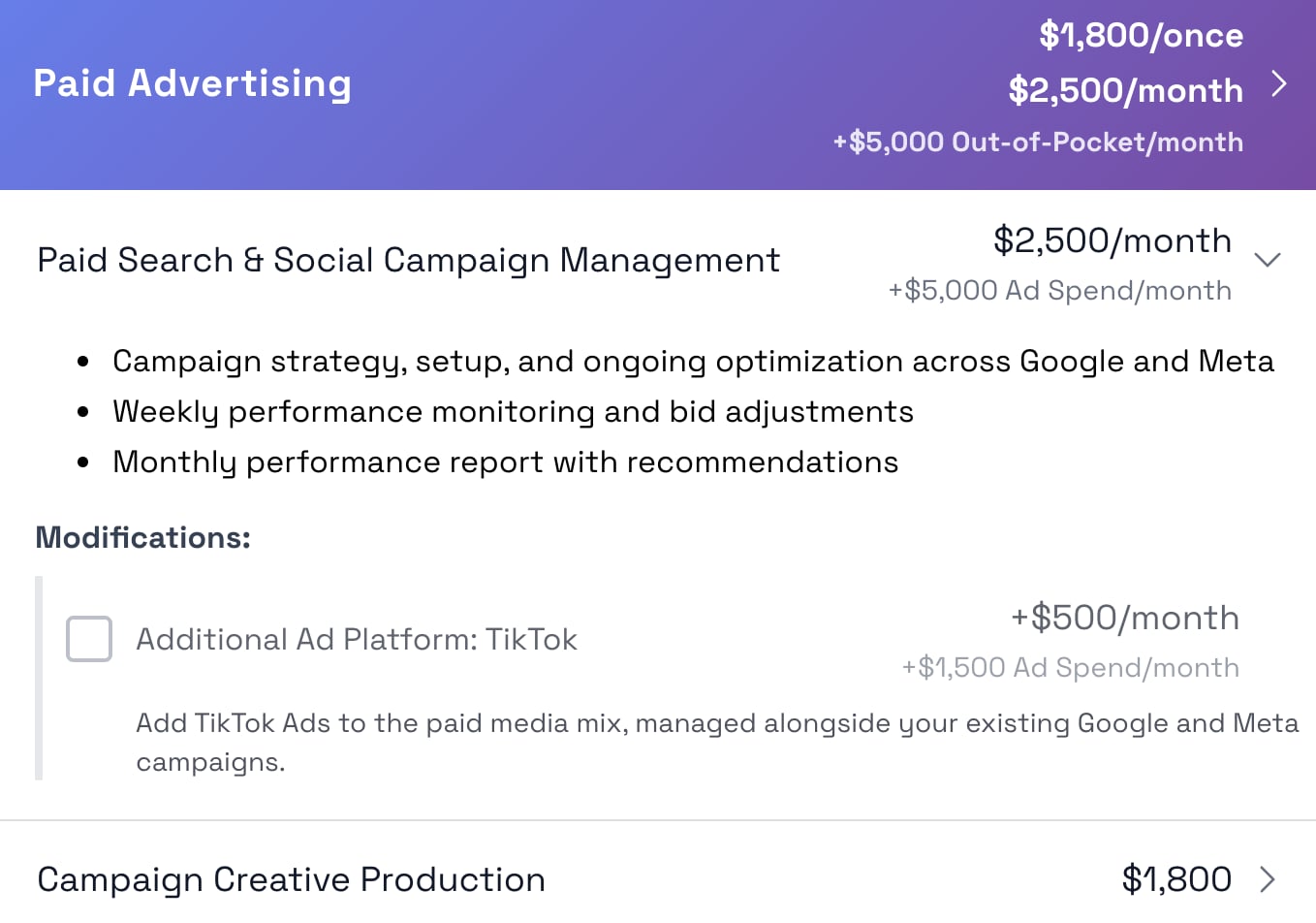
Attach a pass-through cost to any line item and it totals on its own line, apart from what you charge for your work. A $2,500/month management fee and $5,000/month of ad spend stay two different numbers instead of one confusing total.
This is how you quote money you spend on a client's behalf: ad spend, media placements, software licenses, hosting renewals. You are not marking it up and you are not hiding it, so the proposal should not make it look like your fee.
Which Costs Are Out-of-Pocket?
The test is simple: if you are buying it for your client and handing it over at cost, it is out-of-pocket. If you are doing the work, it is your fee. Here are the four we hear about most.
Ad Spend
The media budget you place on a client's behalf, kept apart from what you charge to run the campaign. Charge $2,500/month to manage the work and show the $5,000/month of spend as its own number.
Media Placements & Sponsorships
Podcast sponsorship slots, influencer fees, print buys, and out-of-home placements you book for a client. The placement is their cost. Booking and managing it is your fee.
Third-Party Software & SaaS Licenses
AWS, Salesforce, security tooling, and any other license you resell at cost. IT companies and MSPs use this constantly, because a license pass-through has nothing to do with the value of the managed service around it.
Domain, SSL & Hosting Renewals
Annual fees you pay to a registrar or hosting provider and rebill later. Small amounts, but they are the ones that trigger the "what is this charge?" email if the proposal never called them out.
Two Totals, No Surprise at Invoice Time
The split follows the proposal all the way up. Group headers and proposal totals each show two numbers: what they pay you, and what they fund through you.
Proposal totals
Your fees
$7,300 once
$8,500 /month
Out-of-pocket
$1,700 once
$5,000 /month
Nobody compares your $8,500/month against another agency's $8,500/month without noticing that yours includes a $5,000 media budget. The walkthrough shows the setup, and it works alongside everything else in your interactive pricing tables.
A short walkthrough of pass-through costs on line items, modifications, and totals.
Who Passes Costs Through?
If you buy something for a client and hand it over at cost, your proposal should say so. These are the four businesses that reach for this first.
Marketing Agencies
Separate your management fee from the ad spend behind it. Charge $2,500/month to run paid search and social, and show the $5,000/month media budget as an out-of-pocket cost the client funds.
PR & Media Firms
Sponsorship slots, influencer fees, and print or out-of-home buys are the client's money moving through your account. Quote the placement at cost and price your strategy work on its own line.
IT Companies & MSPs
Pass through SaaS licenses, security tooling, and cloud costs at what you pay for them. The managed service keeps its own price, and a license increase never looks like a rate increase.
Web & Development Shops
Domains, SSL certificates, and hosting renewals get paid by you and rebilled later. Naming them in the proposal is the difference between an expected line item and a support ticket.
Not sure this is the piece you need? Compare it with the rest of your pricing controls, or see how everything comes together in an interactive pricing table.
Your Fee Should Not Look Like Their Budget
Out-of-pocket expenses fix a specific problem: one number in a proposal that is really two numbers. Here is what changes when you split them.
Fees and Costs Stay Apart
Out-of-pocket amounts total on their own line at the group level and the proposal level. Your service revenue never gets padded by money you are only passing along.
The Client Sees the Split
$8,500/month plus $5,000 Out-of-Pocket/month reads clearly to a buyer. No footnote, no follow-up call to explain which part you keep.
Use Your Own Labels
Call it Ad Spend on the line item and let it roll up as Out-of-Pocket at the totals. The wording matches how your clients already talk about it.
Works on Optional Items
A modification can carry a fee and a pass-through cost at the same time. Unchecked it counts for nothing, checked it moves both totals correctly.
No Invoice Surprises
The costs your client agreed to fund are named in the proposal they signed. That is the cheapest way to prevent a billing dispute later.
Off Until You Want It
It is a paid add-on, so the core pricing table stays clean for everyone who does not pass costs through. Turn it on when your work calls for it.
Ready to Split Your Fees From Your Pass-Through Costs?
Out-of-Pocket Expenses FAQ
Common questions about out-of-pocket expenses and pass-through costs in Smart Pricing Table.
Can I show ad spend separately from my management fee in a proposal?
Yes. That is exactly what the Out-of-Pocket Expenses add-on does. On a "Paid Search & Social Campaign Management" line item you can charge $2,500/month as your fee and attach $5,000/month of ad spend as an out-of-pocket amount. The two never get added together. Your client sees $2,500/month for your work and $5,000/month for the media budget you are placing on their behalf.
What are out-of-pocket expenses in a proposal?
An out-of-pocket expense is money you spend on your client's behalf and pass through to them, rather than a fee you charge for your own service. Common examples are ad spend, podcast sponsorship slots, influencer fees, print and out-of-home placements, third-party software and SaaS licenses like AWS or Salesforce, and domain, SSL, or hosting renewals. In Smart Pricing Table these amounts attach to a line item but total on their own line.
Does the client see pass-through costs separately?
Yes. The split shows up at every level of the proposal. A group header might read $1,800/once, $2,500/month, and +$5,000 Out-of-Pocket/month. The proposal totals split the same way, for example $7,300/once plus $1,700 Out-of-Pocket/once and $8,500/month plus $5,000 Out-of-Pocket/month. Nobody has to work out which part of the number was your fee.
Can I use a custom label like "Ad Spend" instead of "Out-of-Pocket"?
Yes. You can set a custom label on the line item so it reads in your client's language. A campaign management item can show "+$5,000 Ad Spend/month" while the group header and the proposal totals roll it up under the general "Out-of-Pocket" label. Use whatever your clients already call it: ad spend, media budget, licenses, or placements.
Can I attach an out-of-pocket amount to an optional item the client can turn on?
Yes. Out-of-pocket amounts work on modifications as well as line items. A modification called "Additional Ad Platform: TikTok" can carry +$500/month for your fee and +$1,500 Ad Spend/month in pass-through cost. If the client leaves it unchecked, neither amount counts. If they check it, both totals move at once and each stays in its own column.
Who uses out-of-pocket expenses in proposals?
Marketing agencies use it most, usually for ad spend they manage on a client's behalf. PR and media firms use it for sponsorships, influencer fees, and paid placements. IT companies and MSPs use it to pass through SaaS and security licenses at cost. Web and development shops use it for domain, SSL, and hosting renewals they pay for and rebill. If you buy something for a client and hand it over at cost, this is for you.
How do I turn on Out-of-Pocket Expenses?
Open the add-ons library at web.smartpricingtable.com/addons and switch on Out-of-Pocket Expenses. After that, any line item or modification can carry an out-of-pocket amount and a custom label. There is a short walkthrough video in the help center if you want to see the setup before you enable it.