To make MSP proposals consistent across your sales team, put three things in place: a shared library of standardized service line items, one pricing model everyone follows (per user, per device, or tiered), and reusable proposal templates so no rep starts from a blank page. Do that and every quote that leaves your shop looks, reads, and prices the same, no matter who built it.
Most managed services providers do not have a proposal problem. They have a consistency problem.
One rep quotes per device. Another quotes per user. A third copies last quarter's pricing and forgets it went up. Someone leaves off the backup add-on. The scope language is different on every document. None of it is a disaster on its own, but together it leaks margin, slows down your close, and makes onboarding a new salesperson painful.
Here is how to fix it, in the order that actually moves the needle.
Why MSP proposals drift out of sync in the first place
Inconsistency is rarely about lazy reps. It is about the system they work in. When every proposal starts from a copied Word doc or a shared spreadsheet, small drift is guaranteed:
- Pricing drift: old numbers get copied forward, discounts creep in, and two clients on the same plan pay different rates.
- Scope drift: what counts as "managed" is described differently on every proposal, which invites scope creep later.
- Missing items: a rep forgets the security audit, the onboarding fee, or the optional add-ons that carry your margin.
- Brand drift: layout, tone, and structure vary, so a $6k/month retainer can look less credible than it should.
The goal is not to police your team. It is to build a system where sending a consistent, correctly priced proposal is the easy path.
Start with a standardized service catalog
The single highest-leverage fix is a shared library of reusable line items: your managed IT plans, backup and disaster recovery, security audits, cloud migrations, help desk tiers, per-device and per-user rates, and every common add-on. Build it once, price it once, and have every rep assemble proposals from the same approved building blocks.
This is the same idea behind a service catalog that wins proposals on speed: when the pieces are pre-built and pre-priced, quoting becomes assembly, not authorship. Consistency comes for free because everyone is drawing from one source of truth.
Lock in one pricing model: per user, per device, or tiered
Most MSP inconsistency traces back to a pricing model that was never actually decided. Pick one primary model and standardize it:
- Per user: a flat monthly rate per employee, covering all their devices. Simple for clients to understand and easy to forecast.
- Per device: priced by workstation, server, and network device. Fits shops with heavy infrastructure or shared workstations.
- Tiered / bundled: good/better/best packages (for example, Essential, Managed, Fully Managed) with clear feature differences, plus one-time projects quoted separately.
There is no universally "right" model, but there is a wrong outcome: reps guessing. Once you choose, your pricing becomes a template every proposal inherits, which is exactly what people are reaching for when they search for a "managed services pricing template" or an "MSP pricing spreadsheet." A template locks the model in so the math is the same every time. If you want a deeper framework for setting the actual numbers, our guide on how to price services with clarity and confidence walks through it.
Retire the MSP pricing spreadsheet
A spreadsheet feels like control, but it is where consistency quietly dies. Formulas break, tabs get duplicated, and the "final_v3_USE THIS" file is never actually the one the newest rep opens. Worse, a spreadsheet still has to be copied into a proposal by hand, which reintroduces every error you were trying to prevent.
The fix is a single system where your pricing model, your line items, and the client-facing proposal are the same object. Update the plan once and every new proposal reflects it. That is the core reason MSPs move from spreadsheets to purpose-built MSP and IT proposal software.
Build reusable templates for each proposal type
Not every deal is the same, so standardize the handful of shapes you actually send:
- New-client onboarding (recurring plan + one-time onboarding project)
- Contract renewal or plan upgrade
- One-off project (a migration, a security audit, a network rebuild)
Turn each into a locked template. A rep opens the right one, swaps in the client details, and sends. You can see fully interactive versions on our IT and MSP proposal template examples, then duplicate whichever matches the deal in front of you.
Show recurring and one-time pricing the same way, every time
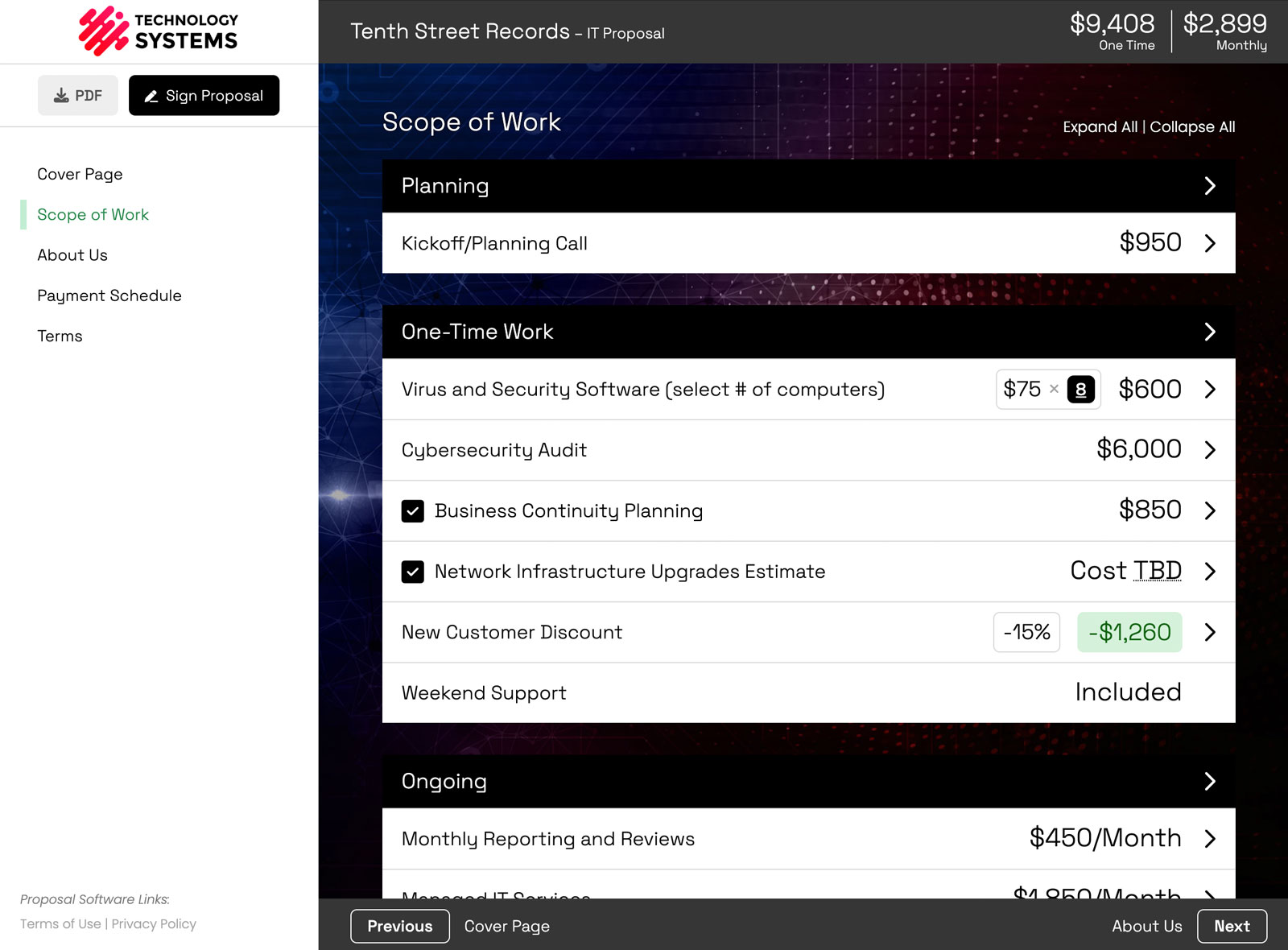
MSP quotes are uniquely messy because they mix monthly recurring revenue with one-time fees and optional add-ons. Inconsistency thrives in that mess. The answer is an interactive pricing table that presents recurring and one-time costs in one place, with the total updating live as the client toggles options.
When the format is fixed, your team cannot accidentally present it three different ways, and the client always sees a clear split between what they pay monthly and what they pay once.
Give reps guardrails, not a blank canvas
Consistency holds when the system enforces it. Instead of trusting everyone to remember the rules, build the rules into the proposal: single-select package choices so a client picks exactly one tier, quantity controls on per-user and per-device items, discount-exempt line items so core services cannot be marked down, and the ability to hide or lock pricing where you need to. Guardrails like these let reps move fast without going off-script, which is the whole point of standardization.
or start a free trial and standardize your next proposal.
Frequently Asked Questions
How do I keep MSP proposals consistent across a sales team?
Give every rep the same building blocks: a shared library of standardized service line items, one agreed pricing model (per user, per device, or tiered), and reusable templates for each proposal type. When proposals are assembled from approved components instead of written from scratch, pricing, scope, and branding stay consistent automatically, and new reps get up to speed far faster.
What is the best pricing model for an MSP proposal?
The three common models are per user, per device, and tiered bundles. Per user is simplest for clients to understand, per device fits infrastructure-heavy environments, and tiered packages make upsells clear. The best choice depends on your client base, but the key move is to pick one, standardize it as a template, and stop letting reps decide case by case.
Is a spreadsheet good enough for MSP pricing?
A spreadsheet works when you are small, but it breaks down as you scale a team. Formulas get overwritten, versions multiply, and numbers still have to be copied into the proposal by hand, which reintroduces errors. Moving your pricing model and line items into proposal software gives you one source of truth that flows straight into a client-facing quote.
How do I quote recurring and one-time fees in the same proposal?
Use an interactive pricing table that separates monthly recurring costs from one-time project fees and optional add-ons, with the total updating as the client selects options. This keeps every MSP quote in a consistent format and makes it obvious to the client what they pay monthly versus once.
Explore more
Purpose-built for managed services
Try an interactive example
Step-by-step with pricing
You might also like
How to Write an MSP Proposal (With Pricing Example)
A step-by-step walkthrough of a managed services proposal, including how to present recurring and one-time pricing.
The Hidden Power of a Service Catalog
Why a library of reusable, pre-priced services is the fastest path to consistent, quick-to-send proposals.
How to Price Services: A Practical Guide to Clarity and Confidence
A framework for setting prices you can defend, so your pricing model holds up across every deal.